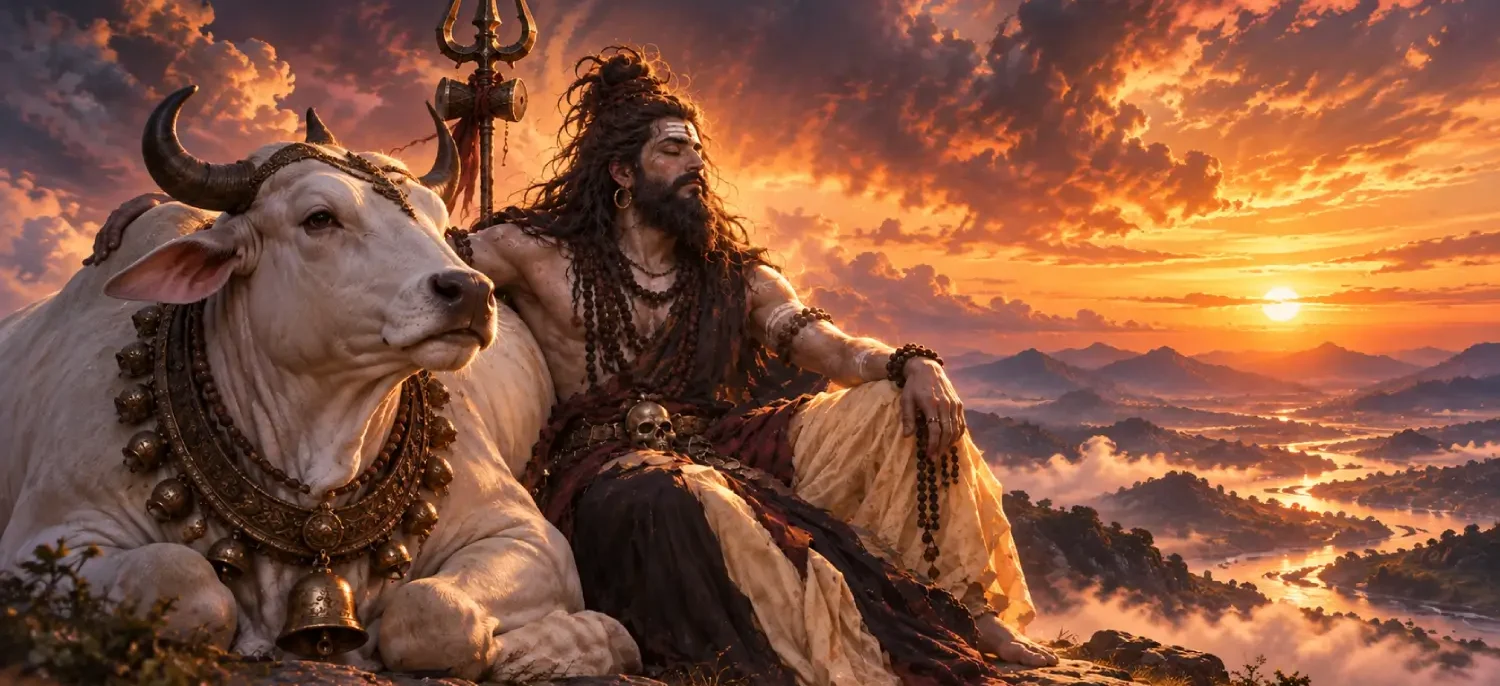
Before the sun, before the moon, before the first star, there was nothing.
No day. No night. No earth to stand on and no sky above it. No sound, no light, and not even darkness, because even darkness needs light to be missing. There was no time either, so nothing could begin and nothing could end.
And yet, in that stillness, someone was there.
The old sages tried hard to put this into words. The Shvetashvatara Upanishad says it in one line:
यदाऽतमस्तन्न दिवा न रात्रिर्न सन्न चासच्छिव एव केवलः ।
yadā ’tamas tan na divā na rātrir na san na cāsac chiva eva kevalaḥ
“When there was no darkness, no day and no night, nothing that was and nothing that was not, there was only Shiva, alone.”
Only Shiva. Not a god sitting somewhere inside an empty space, because there was no space yet. Just him. Pure awareness, with no shape, no name and no second thing beside him. He had no beginning, because there was no “before” for him to come from. Nobody made him. He simply was.
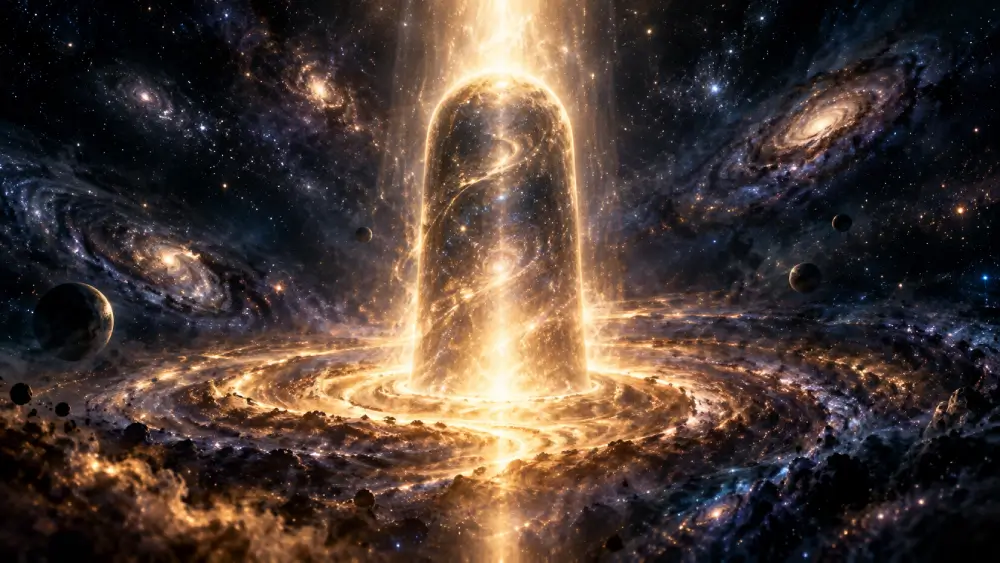
Then, in that endless silence, came a wish.
The Shiva Purana says the formless one wished to become many. So, for the very first time, he took a form. The Purana calls this first form Sadashiva, the one who is always auspicious. And with him appeared his own power, his Shakti, the Mother of all, whom the Purana calls Ambika. Shiva and Shakti were never really two. Like fire and its heat, one cannot be without the other.
Next, the Purana says, a shining being came forth from Shiva. He was calm, dark like a rain cloud, with eyes like lotuses. Shiva named him Vishnu and gave him a task: to protect everything that would one day be created.
Vishnu sat in deep tapas for a very long time. From his effort, waters began to flow, and they filled the endless space. Tired, Vishnu lay down on those waters and fell asleep. That is why one of his names is Narayana, the one who rests on the waters.
As he slept, a lotus grew out of his navel and rose above the waters. On that lotus, a new being opened his eyes. He had four faces, looking in four directions, and in every direction he saw only water.
This was Brahma.
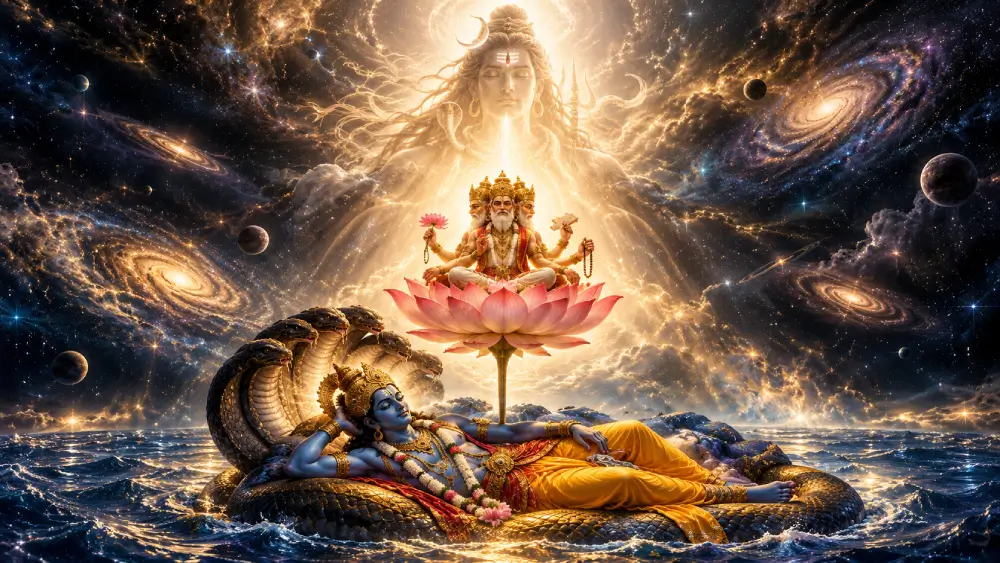
Brahma did not know who he was or where he had come from. He climbed down the lotus stem for ages, looking for its root, and never found it. Confused, he climbed back up. And there, on the waters, he met Vishnu.
“Who are you?” Brahma asked.
Vishnu smiled. “I am the one you came from. Your lotus grew out of me.”
Brahma did not like that answer at all. “I am the creator,” he said. “Everything will come from me. I am the greatest.”
“No,” said Vishnu. “I am.”
Their words grew louder and hotter. Two of the greatest powers in all creation, each one sure that he came first.
And then, right between them, the darkness split open.
A pillar of fire rose up out of nowhere. It was so bright that both of them had to cover their eyes. It had no top that anyone could see, and no bottom. It went up past every height and down past every depth, burning with a light that never flickered.
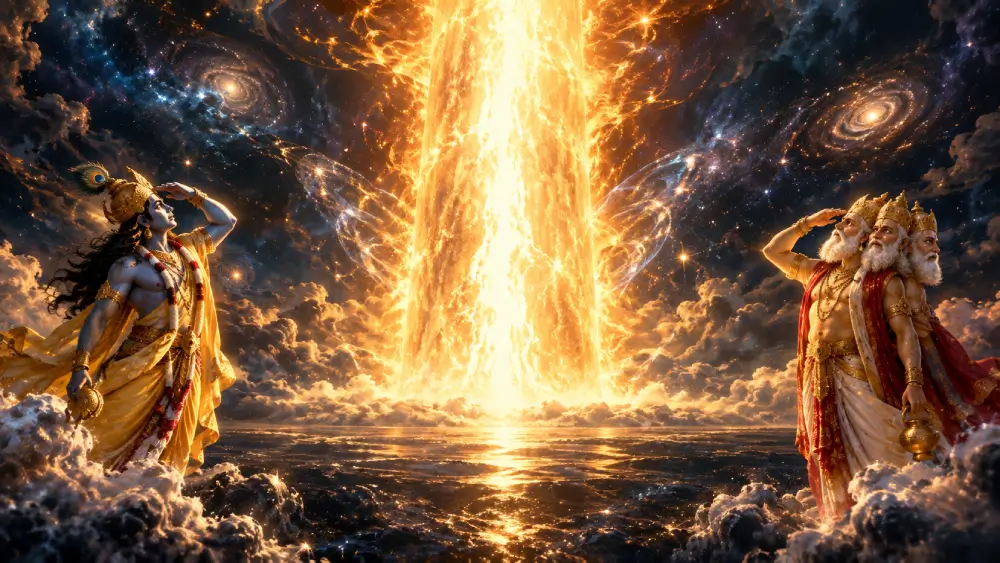
Both gods fell silent.
“Whoever finds the end of this pillar,” they agreed, “is the greater one.”
Brahma became a swan and flew upward. Vishnu became a great boar and dug downward. They travelled for what felt like thousands of years.
Vishnu went deeper and deeper, and the pillar kept going. At last he stopped. He came back up, tired and humble, and said simply, “I could not find its end.”
Brahma flew higher and higher, and the pillar kept going there too. On the way, he saw a small ketaki flower drifting down from above.
“Where are you coming from?” he asked.
“From the top of this pillar,” said the flower. “I have been falling for ages.”
Brahma had an idea. He asked the flower to say that he, Brahma, had reached the top. The flower agreed.
Brahma came back down and announced, “I have seen the top of the pillar. This flower is my witness.”
At that moment the pillar opened, and Shiva stepped out of the fire.
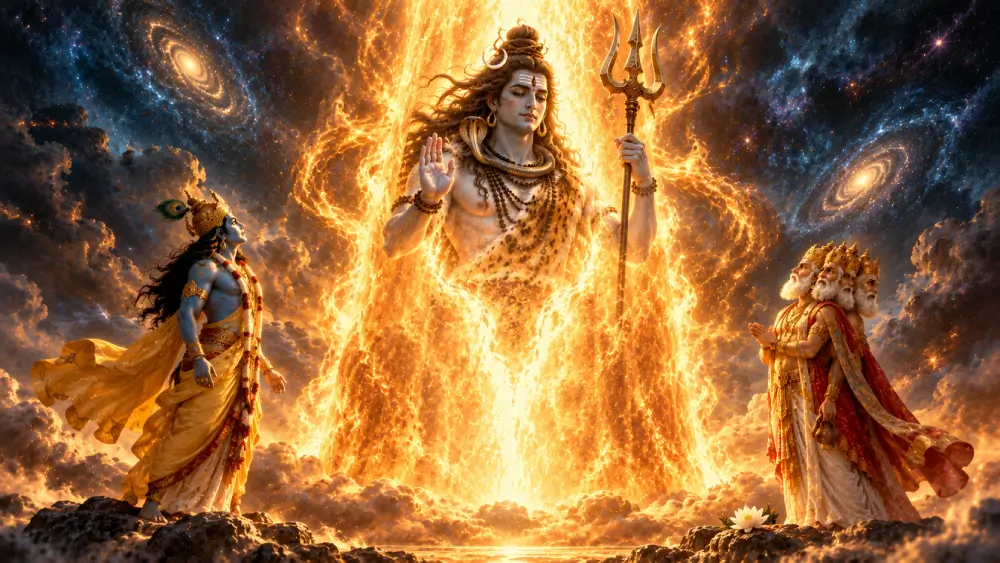
He looked at Vishnu, who had told the truth, and blessed him and honoured him. Then he turned to Brahma. Because Brahma had lied, Shiva said, he would not be worshipped in temples the way other gods would be. And the ketaki flower, for lying with him, would never again be offered to Shiva. Even today, you will rarely see a ketaki flower in Shiva puja.
Then Shiva told them the truth about the pillar. It was not really a pillar. It was him. Vishnu could not reach its beginning and Brahma could not reach its end, because he was there before anything began and would be there after everything ended. From that day on, he said, he would be worshipped in this form, as the linga, which means “the sign”. A sign for the one who has no shape.
The Shiva Purana says this is how the worship of the Shivling began. Many devotees also remember this as the story behind the holy night of Shivaratri.
So, who is Shiva?
He is the one who was there when nothing was there. He is the light that Brahma could not fly above and Vishnu could not dig below. He is the silence before the first sound, and the silence after the last one.
Every form of Shiva you will meet in these stories, the yogi on Kailash, the husband of Parvati, the father of Ganesha, the dancer, the archer, is that same endless light, choosing to take a shape for a while.
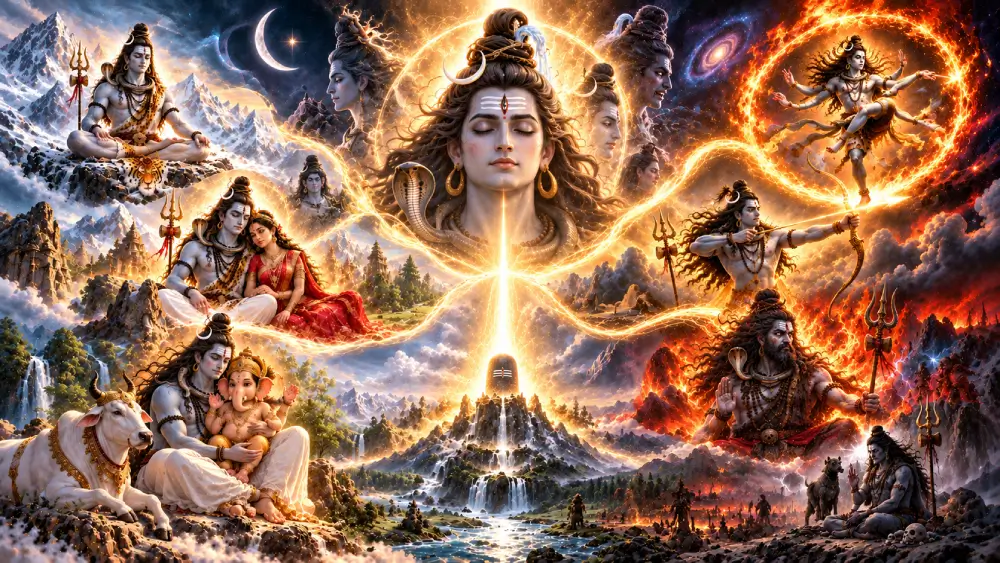
So next time you pour water on a Shivling, remember what it really is. Not just a stone. A small piece of that pillar of fire, with no top and no bottom.
But the story does not end here. Brahma, now humble, still had a whole world to create, and he did not know how to begin. He folded his hands and asked Shiva for help. Shiva promised that he would come to him again, from inside Brahma himself, in a fierce new form.
That form would be called Rudra.
Next in Shiva Tales: How Shiva came into the world as Rudra.
Your turn: when you stand in front of a Shivling, what do you feel? Tell us in the comments.
Sources for this story: Shvetashvatara Upanishad 4.18; Shiva Purana, Rudra Samhita (Srishti Khanda) and Vidyeshvara Samhita; Linga Purana, Purva Bhaga. This is the story as the Shaiva books tell it. Some other Puranas, like the Vishnu Purana, describe the start of creation with Vishnu first.