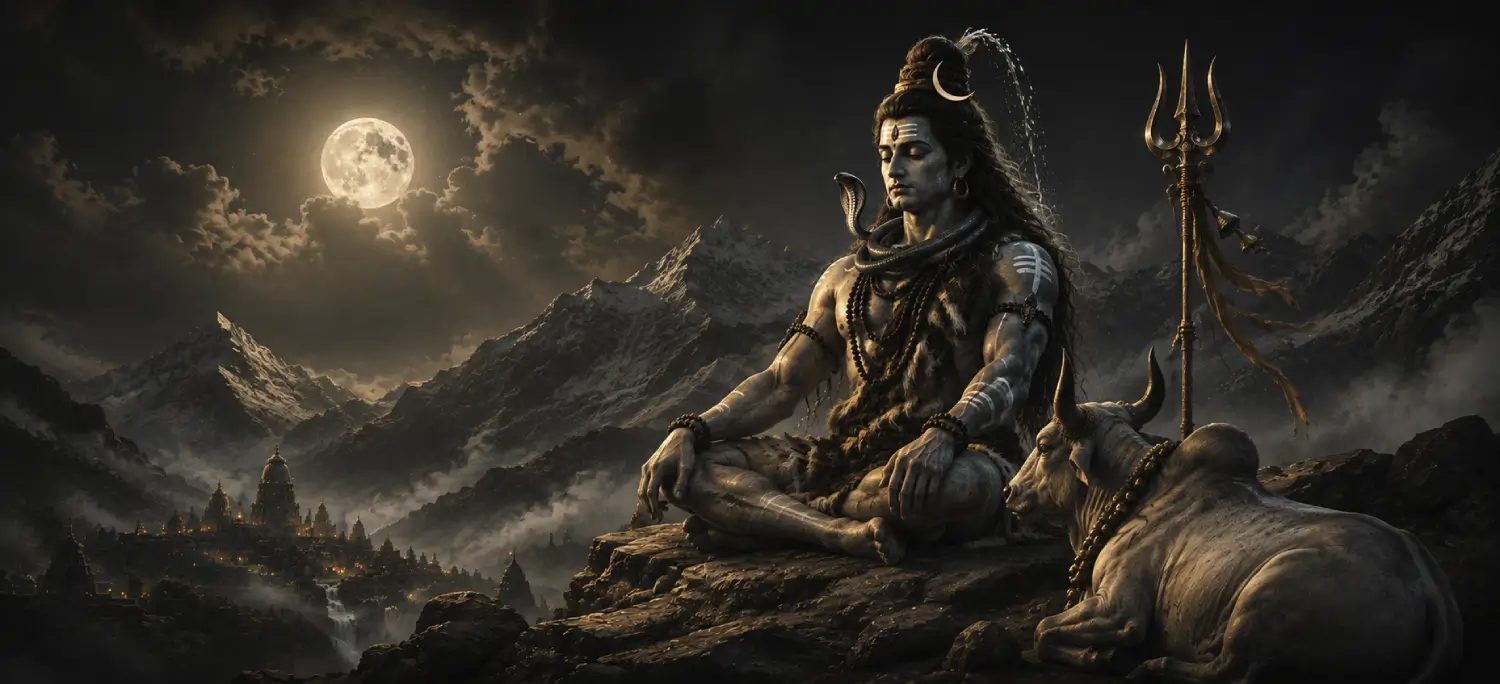
Lord Shiva is one of the principal deities of Hindu traditions and is especially central to Shaivism.
He is known by many names, including Mahadev, Shankara, Neelkanth, Maheshwara and Rudra.
Shiva is associated with many ideas that can appear contradictory at first.
He is a householder and a yogi. He is associated with destruction and renewal. He is depicted in wild landscapes and in intimate family scenes. He is both powerful and deeply still.
Shiva’s Third Eye
The third eye is one of Shiva’s most recognizable symbols.
It is traditionally associated with higher perception and transformative knowledge.
Stories surrounding Shiva’s third eye often connect its opening with powerful transformation.
The Crescent Moon
The crescent moon rests in Shiva’s matted hair.
It is commonly interpreted through ideas of time, cycles and renewal. The moon also connects Shiva’s imagery with the natural rhythms of the universe.
Ganga
The Ganga is traditionally shown flowing from Shiva’s matted hair.
The story describes Shiva receiving the powerful descent of Ganga and allowing her force to be released safely.
The Snake
Shiva is often depicted with a serpent around his neck.
The snake contributes to his image as a deity who exists beyond ordinary fear and attachment.
The Trishul
The trident is one of Shiva’s principal symbols.
Different traditions interpret its three points in different ways. Common interpretations connect them with three cosmic qualities, states or functions.
Nandi
Nandi, Shiva’s bull companion, is commonly found facing the sanctum in Shiva temples.
Nandi represents devotion and is closely connected with Shiva worship.
Why Shiva Remains So Compelling
Perhaps the most interesting thing about Shiva is that he cannot be reduced to one idea.
He represents stillness and transformation. He appears as both ascetic and householder. He lives in the mountains but remains deeply connected with people and family.
That complexity is part of what makes Shiva such a powerful figure in Indian spiritual culture.